

Project Overview
The Automobili Pininfarina B95 project was developed as a fully CG automotive visualisation study in Unreal Engine 5, focused primarily on understanding outdoor cinematography and material response under harsh natural sunlight. The previous McLaren MCL60 study was centred around controlled studio-style lighting, whereas this project deliberately moved into a much less forgiving lighting condition: strong directional daylight, hard shadows, high specular response, bright sky contribution, and a reflective outdoor environment. The source vehicle was a low-poly but comparatively well-textured B95 asset. Rather than rebuilding the vehicle, the project focused on improving its perceived realism through material development, custom automotive paint shaders, environmental construction, surface variation, controlled lighting, and post-production.
The majority of the vehicle's exterior bodywork was replaced with a custom dual-tone automotive paint material, with additional paint variations developed for selected components. I also explored the construction of dual-tone and triple-tone car-paint materials to control layered colour transitions and reflective behaviour under direct sunlight. The project also involved developing a significantly more detailed track environment material system, including asphalt, dirt, concrete, markings, cracks, dust, and surface debris. A major objective was to eliminate repetitive texture patterns while maintaining sufficient surface detail at both close and wide camera distances.
Core Objective
The central objective was to understand how an automotive asset behaves under hard outdoor illumination and how material development must change when moving from controlled studio lighting to natural environmental lighting. Direct sunlight exposes weaknesses that can remain hidden in dark studio environments. Surface roughness, texture repetition, reflection behaviour, shading transitions, material seams, and geometric simplification become much more noticeable. The project therefore treated the vehicle, track, background, sky, and post-production as one integrated image system. The objective was to establish a convincing outdoor photographic response without relying on overly artificial lighting or excessive visual effects.
Vehicle Asset and Material Development
The supplied B95 model provided a workable base in terms of geometry and texture information, but the original body finish did not provide the level of material control required for the final look. The primary exterior paint was therefore replaced with a custom automotive material designed around a dual-tone paint response, allowing two colour regions to transition across the body while maintaining a coherent reflective surface. Additional paint variations were developed for specific components where separate colour and finish control was required. I also explored a triple-tone paint configuration, allowing multiple colour zones to be driven independently while maintaining a consistent underlying material response. The material development concentrated on the behaviour of base colour, metallic response, roughness, specular intensity, and reflection under direct sunlight. This was particularly important on the B95 because its body surfaces contain large smooth transitions that generate broad, high-energy highlights when exposed to a strong directional source.
Automotive Paint Shader Study
One of the primary material-development exercises was understanding how a convincing automotive paint finish can be constructed from relatively simple shader inputs. The custom paint setup was designed so that colour variation remained part of the material response rather than behaving like a flat texture placed over the mesh. The dual-tone transition was therefore controlled within the shader, allowing the colour boundary and reflection behaviour to remain consistent across curved body panels. The triple-tone variation extended the same principle by introducing an additional colour region while preserving a common metallic and reflective response. This approach provided greater control than simply editing the original diffuse texture and made the vehicle surface more responsive to changing lighting conditions.
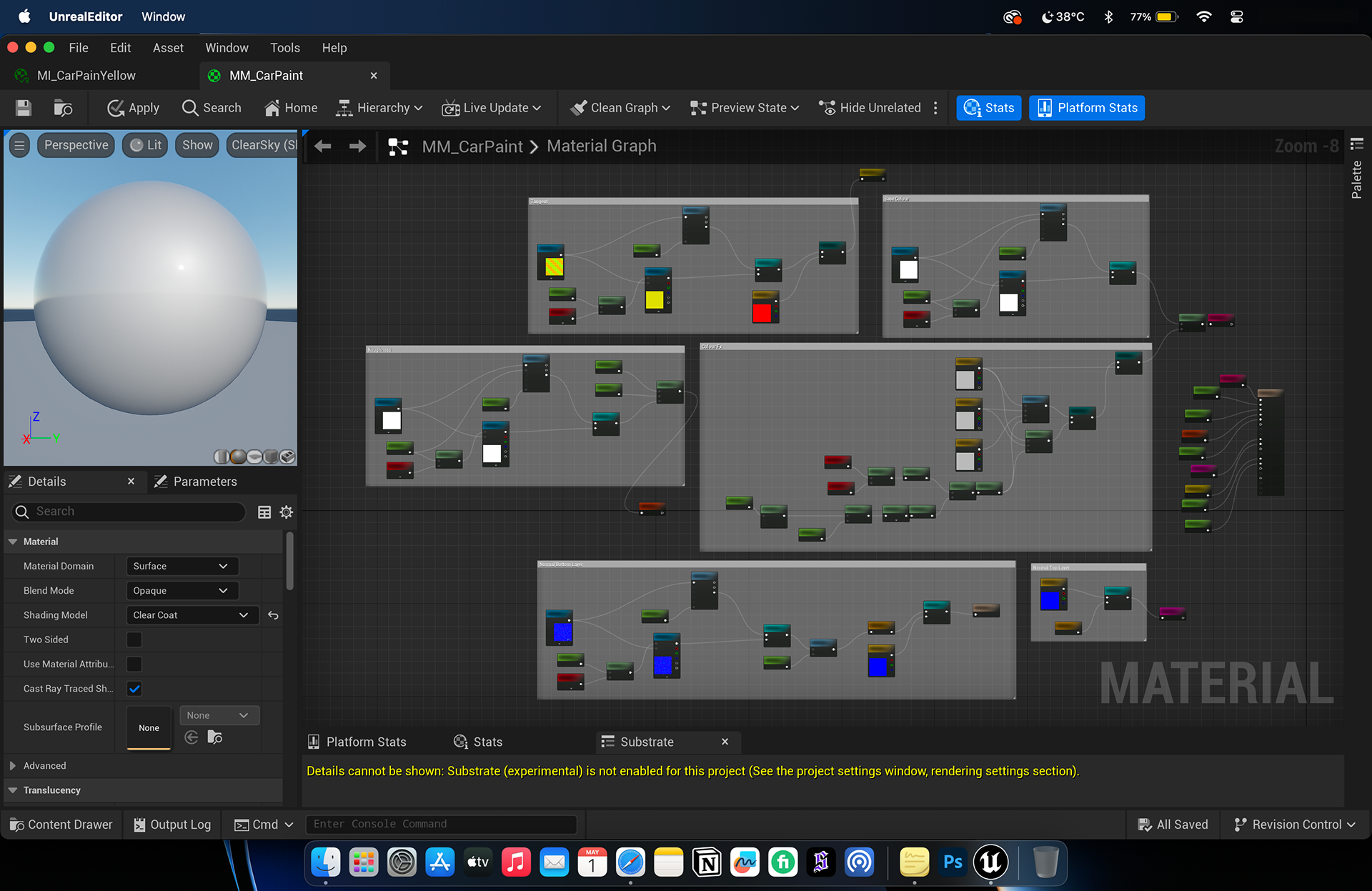

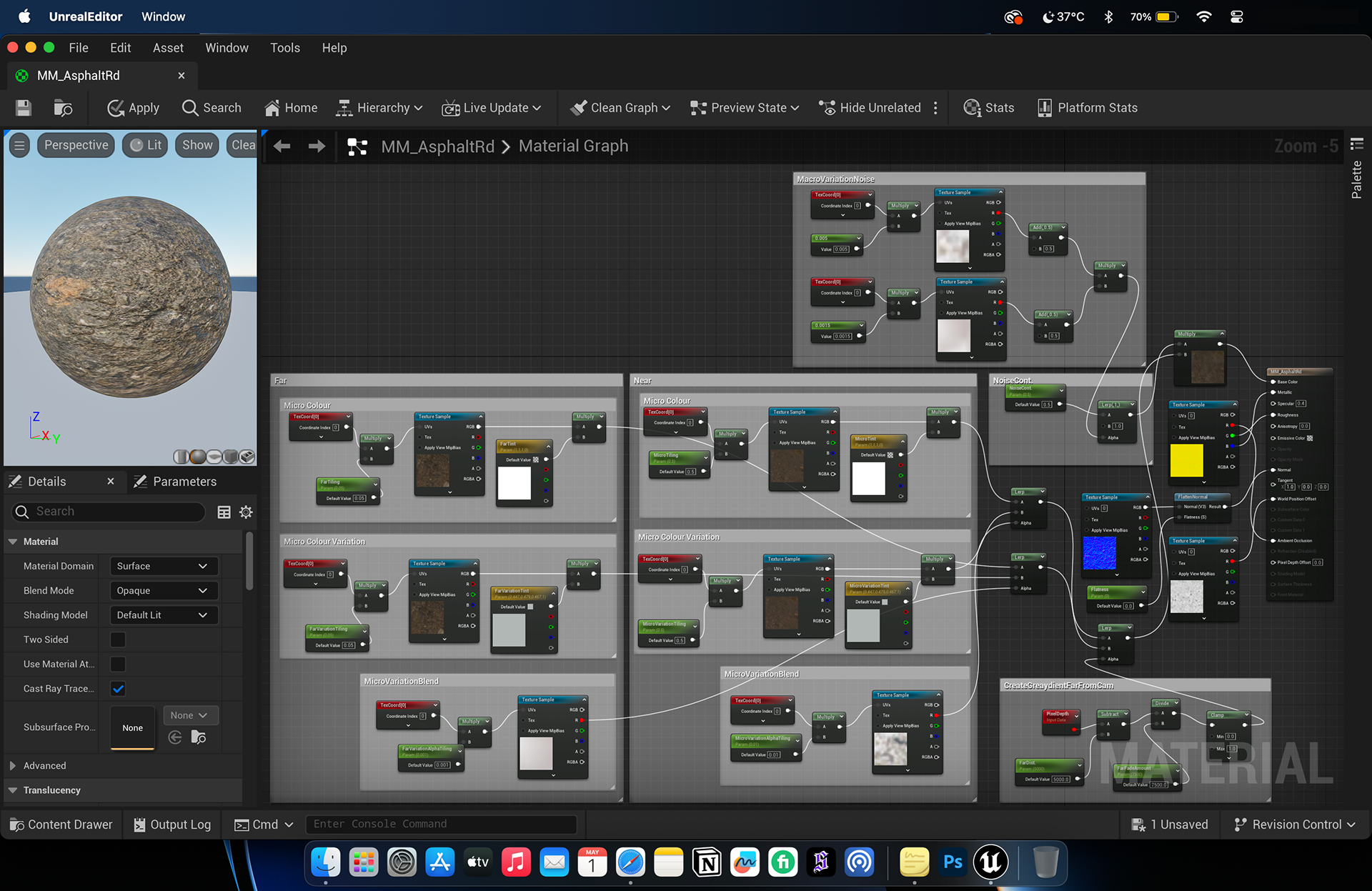
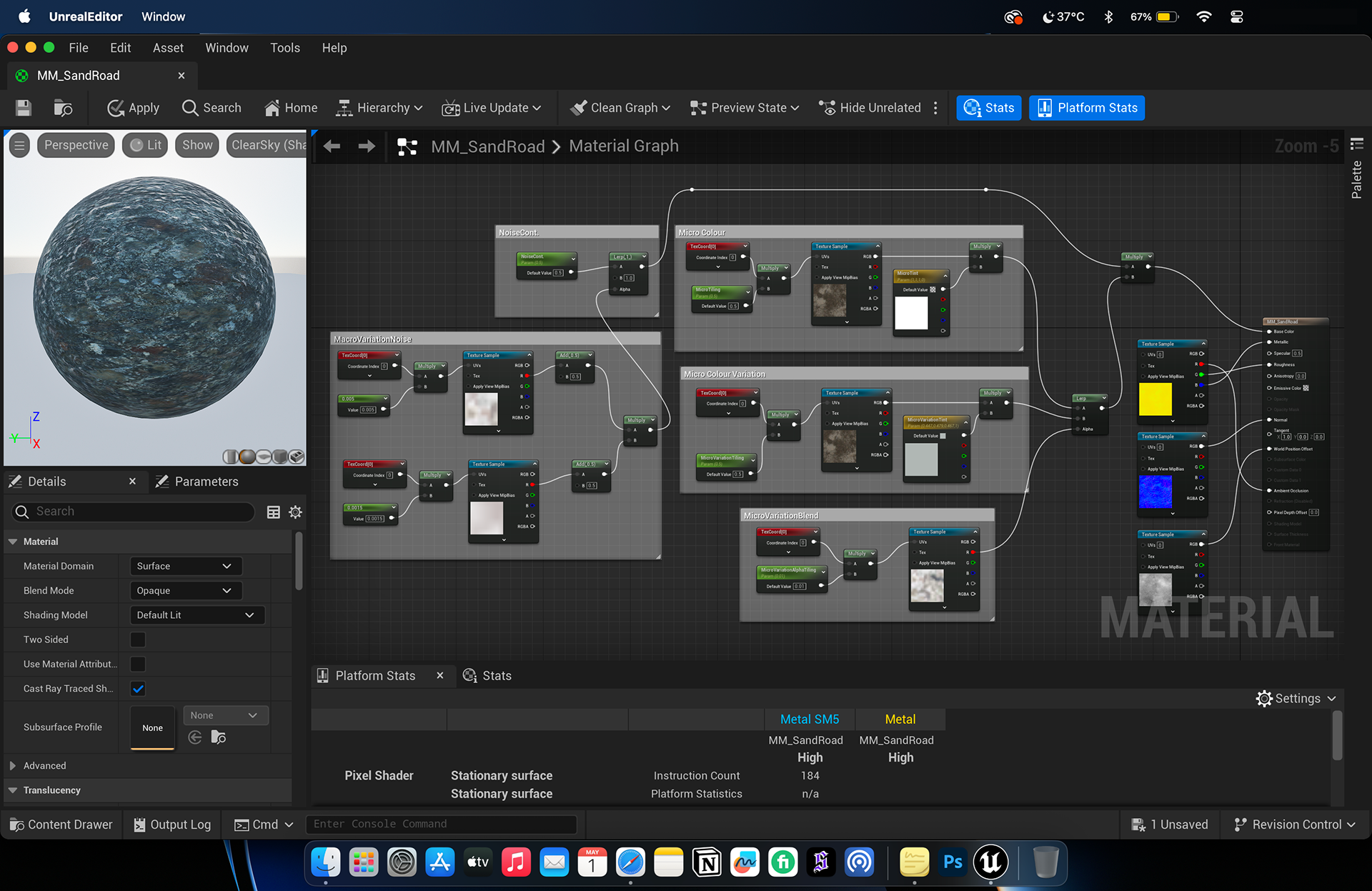
Unreal Engine 5 — Dual-layer Clear Coat shader setup driving flake reflection density, base color tinting, and specular highlights for metallic bodywork. / High-frequency asphalt material graph featuring UV tiling controls, roughness variation maps, and subtle surface detail parameters for modern track surfaces. / Aged asphalt shader node network incorporating weather wear, macro-roughness blending, and cracked detail textures for worn road surfaces. / Multi-texture terrain material combining normal map details, albedo tinting, and specular response parameters for off-road gravel environments.
Outdoor Lighting and Harsh Sun Study
Unlike the controlled studio environment of the previous project, this scene was built around strong directional daylight. The goal was to understand how hard sunlight interacts with large automotive surfaces, glossy paint, exposed carbon elements, glass, tyres, and the track environment. The direct source produced clearly defined highlight regions and harder shadow transitions, while the sky contribution provided secondary illumination into shadowed areas. This created a wider dynamic range than the previous dark studio setups and required more careful control of exposure and material response. The lighting was therefore used not only to illuminate the vehicle, but to reveal its surface curvature through specular highlight travel, shadow definition, and natural environmental reflection.
Environmental Track Development
The race-track environment became a significant technical component of the project. Instead of relying on a single repeating asphalt texture, the existing road material was modified into a more complex landscape-based track material system containing multiple surface categories and variations. The base system incorporated different asphalt and road textures alongside dirt and worn-surface components. These layers were blended spatially to create more natural transitions between the clean racing line, degraded edges, concrete regions, and surrounding ground. The objective was to prevent the track from reading as a flat repeating texture, particularly in the foreground where surface repetition would become highly visible.

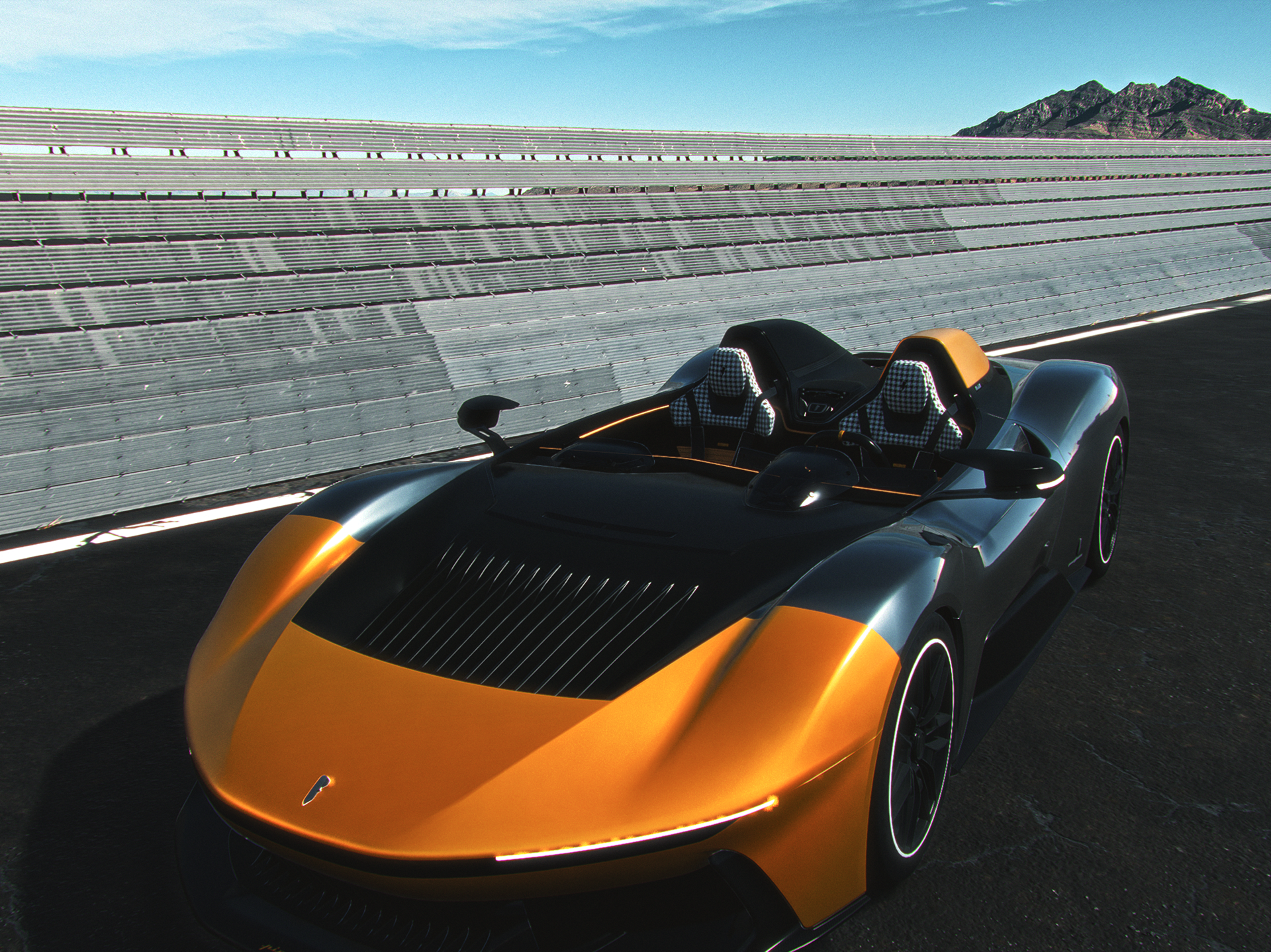
High Isometric Three-Quarter - An elevated overview exposing the major chassis surfaces, hood vents, cockpit opening, rear deck, and side rockers under consistent natural illumination.
Solving Landscape Tiling
One of the main problems with the track environment was texture repetition across the large landscape surface. To solve this, multiple techniques were combined rather than relying on a single UV scale. The material incorporated cell bombing, texture-distance blending, macro-colour variation, micro-colour variation, procedural noise, and controlled blending between surface layers. Cell bombing was used to break up the obvious repetition of source textures by introducing spatially varied texture distribution. Distance-based blending helped change the level of visible surface detail depending on camera proximity, while macro and micro variations prevented large sections of the track from sharing identical colour and tonal patterns. Procedural noise was then used to break up transitions and produce less predictable surface distribution. This layered material approach allowed the same base texture resources to generate significantly more environmental variation across the visible track.
Track Surface Detailing
After the primary landscape material was established, additional surface detail was introduced through decals and secondary texture layers. These included dust accumulation, debris, concrete cracking, damaged paint, worn road markings, and other localised surface imperfections. White racing-line and track-marking paint was also added across the visible racing surface. The markings were deliberately treated as imperfect rather than perfectly clean graphics, with variations and wear introduced to prevent them from looking procedurally generated. Cracks and sections of removed or degraded paint were layered into the track surface to create a more believable relationship between the maintained racing infrastructure and its accumulated environmental wear.
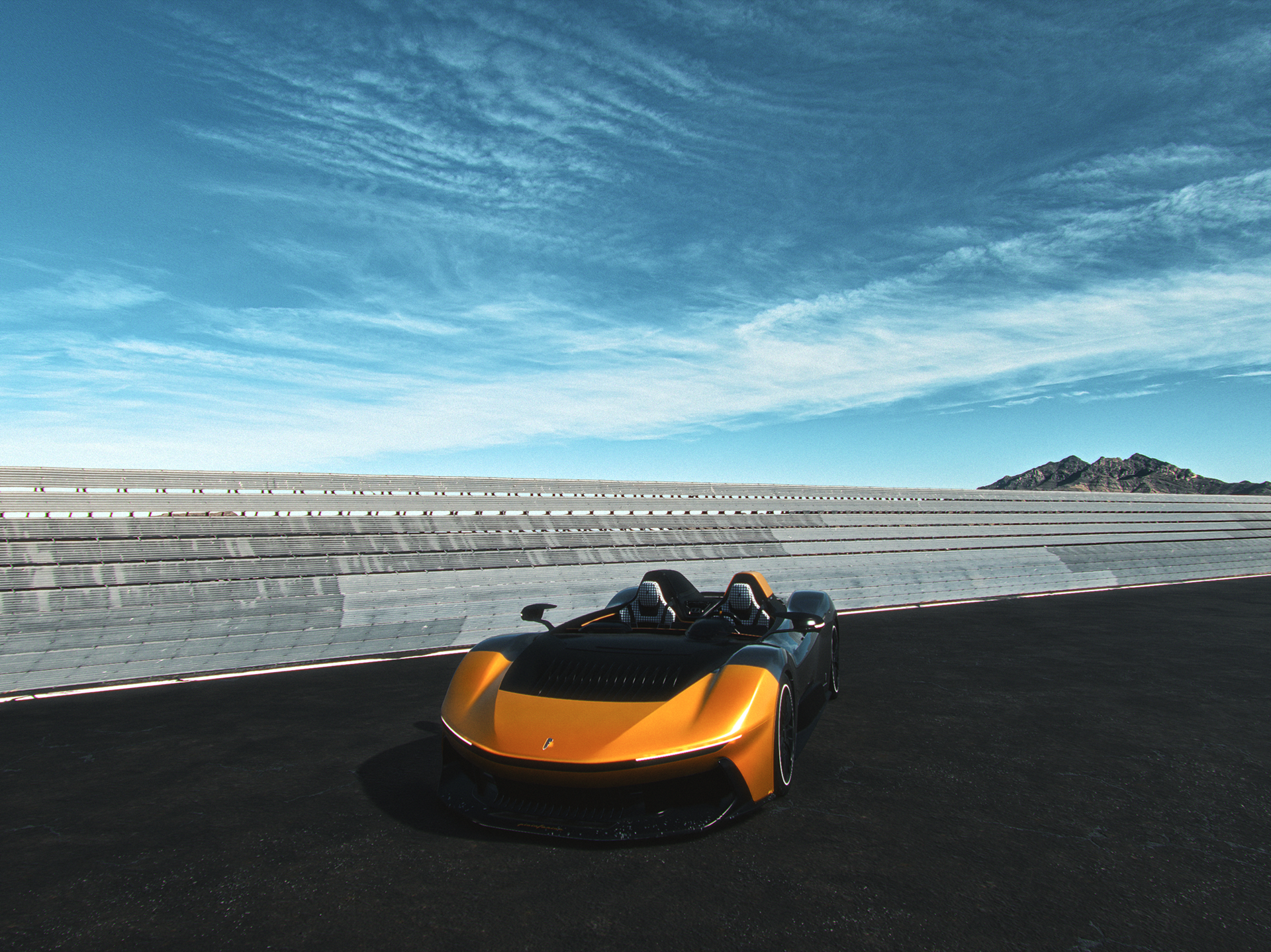

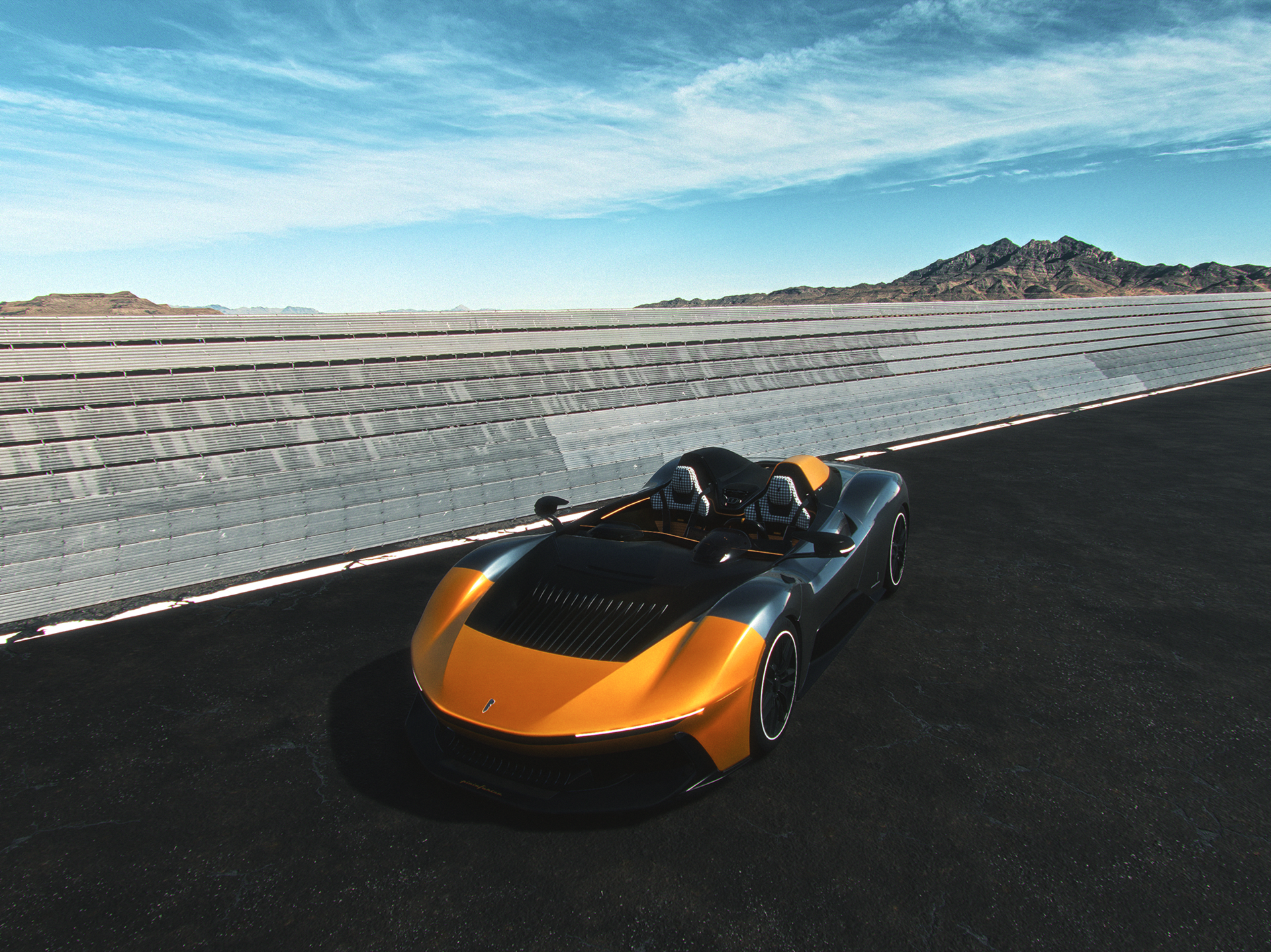
Distant Frontal Perspective - A wide front-facing composition aligning the vehicle with the track boundary and using the low-slung silhouette as the primary geometric focus. / Low-Angle Front Three-Quarter - A ground-level perspective emphasising the front splitter, wheel profile, headrest structure, and low windshield against the bright outdoor environment. / Mid-Range Overhead Front Three-Quarter - A balanced elevated view showing the complete body flow from yellow nose through the cockpit and rear buttresses under high-contrast daylight. / Wide Low-Angle Frontal Approach - A broad ground-level composition balancing the dark asphalt foreground, yellow front bodywork, and expansive sky to reinforce the vehicle's low stance.
Track Marking and Decal Integration
The track markings were constructed as an additional visual layer rather than being embedded only in the base asphalt texture. This made it possible to independently control their placement, wear, colour intensity, edge breakup, and local damage. Dust and debris decals were also used selectively around the road surface to introduce scale variation and break the uniformity of the material response. The combination of procedural material variation and localized decal information was particularly useful in medium and wide shots, where the viewer could simultaneously perceive broad surface variation and individual imperfections.
CGI Background Environment
The primary external environment was sourced from CGI Backgrounds and used as the foundation for the surrounding track and landscape context. Rather than using the background exactly as supplied, several elements were modified to better suit the camera compositions and material response of the scene. The visible flooring was removed where necessary, allowing the Unreal Engine track surface to become the primary ground element. The metallic race-track boundary components were also modified through adjustments to their materials, colour response, and normals. Lighting and the existing camera setup of the supplied environment were also adjusted where possible to better align the background with the vehicle and track.

Tight High-Angle Front Three-Quarter - A detail-oriented view of the front wheel arch, aero mirror support, and bumper guides, using direct sunlight to define the paint curvature.
Background Asset Limitations
The external background presented a significant production constraint because it was designed around a relatively fixed environment and camera setup. The available background had a limited range of usable camera positions and focal perspectives. Moving the camera beyond the intended range could expose the boundaries of the environment, produce perspective inconsistencies, or reveal areas where the set no longer provided sufficient coverage. This meant that camera development had to be performed within the usable envelope of the background asset.
Rather than allowing this limitation to restrict the project to a single composition, I used careful framing, camera repositioning, focal-length adjustments within the viable range, and environmental manipulation to generate multiple distinct compositions while maintaining continuity with the supplied background.
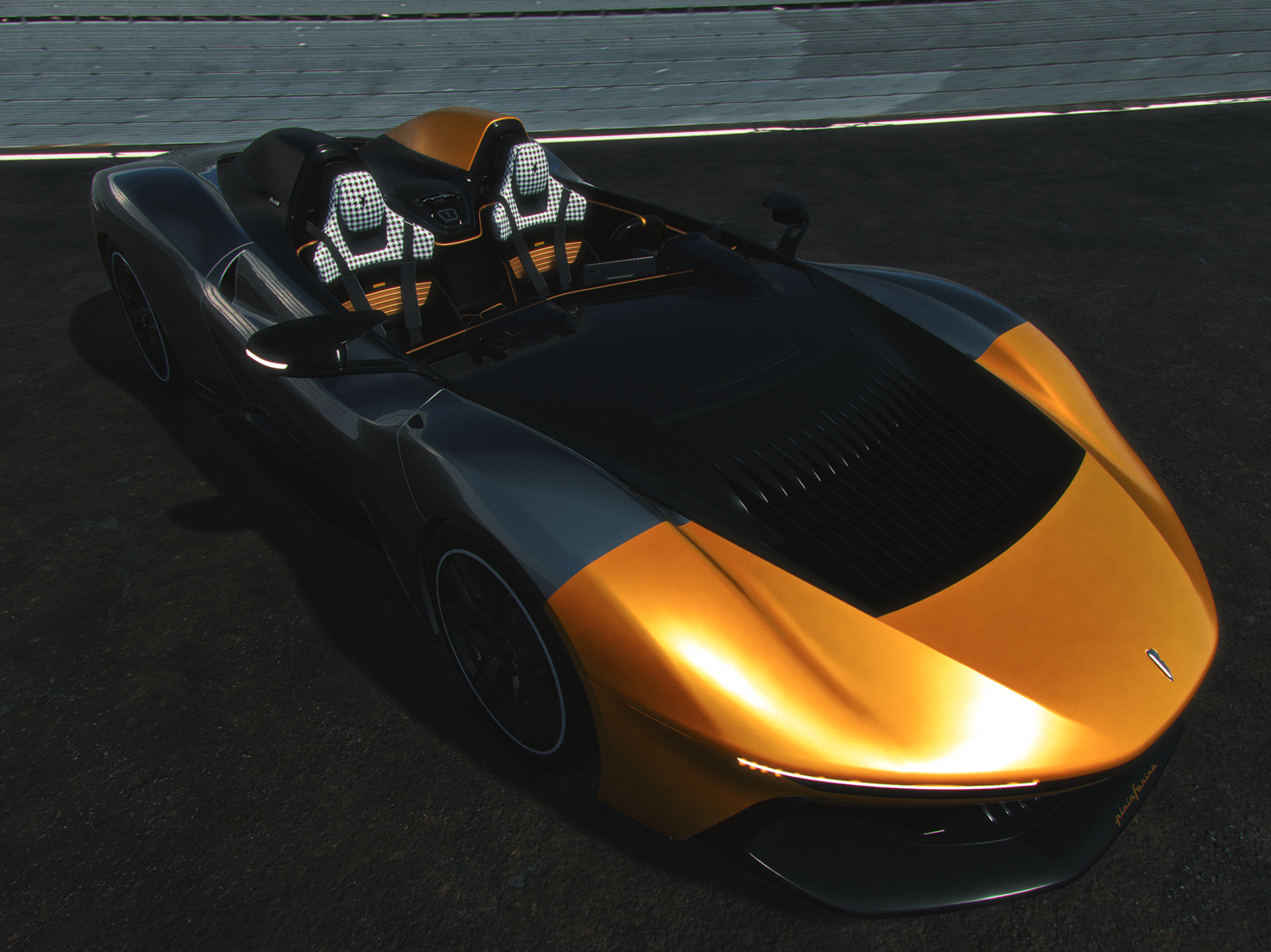
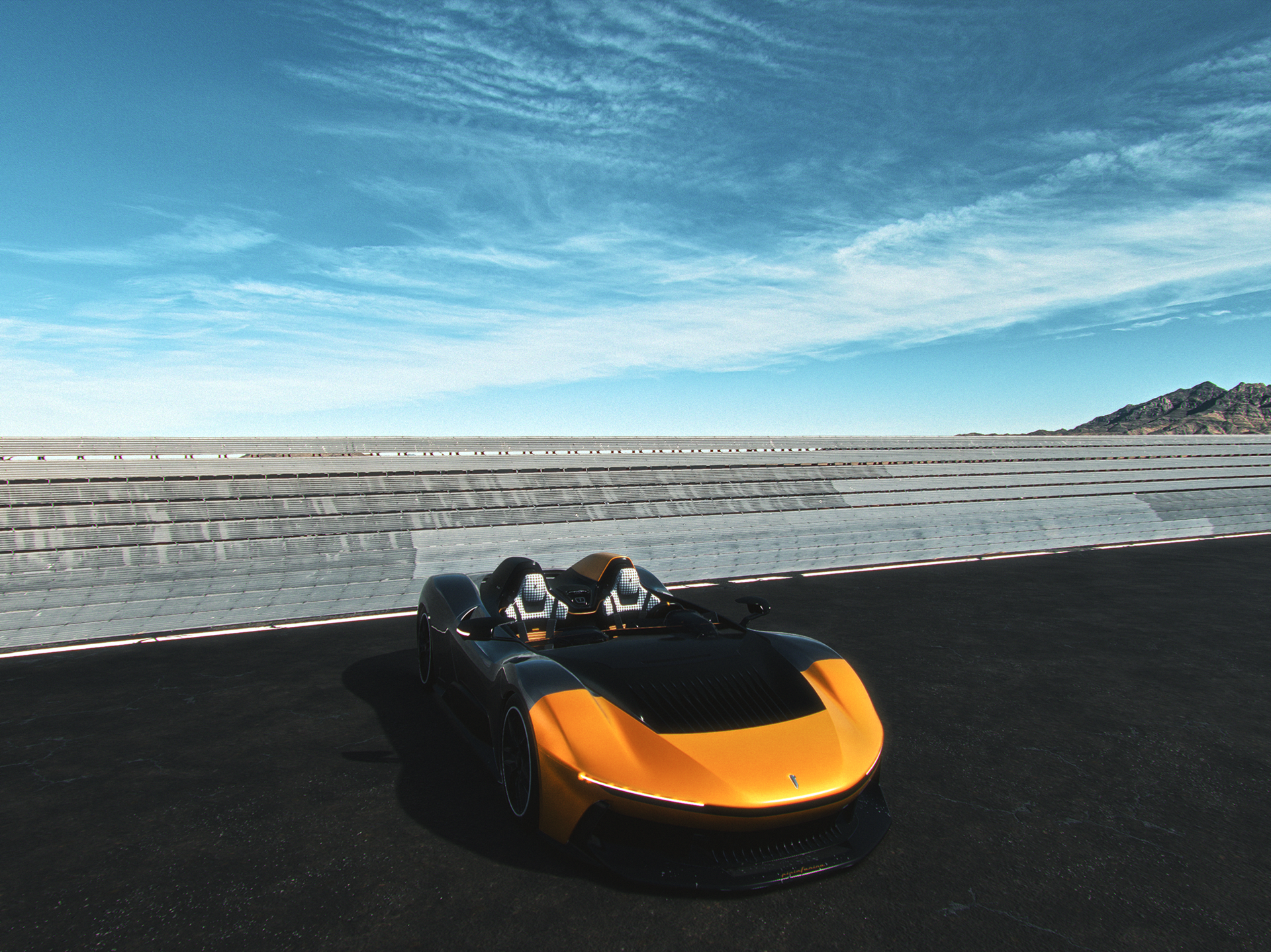


Wide Frontal Track Framing - A centred front composition showing the complete stance against the sweeping concrete barrier, with sunlight defining the low ground clearance and splitter profile. / High Side Profile — Wheel Arch & Sidepod - An elevated side view concentrating on wheel architecture, side intake channels, and the transition between the yellow nose and darker bodywork. / Extreme Wide Side Elevation - A minimalist environmental composition using the low horizon, blue sky, cloud structure, and mountain ridge to emphasise the open-air character of the B95. / Mid-Distance Front Three-Quarter - A track-level perspective integrating the front bodywork with the leading edge of the banked barrier while maintaining a strong colour contrast between the nose and hood.
Camera and Composition Strategy
The camera system was designed around the interaction between the vehicle and the fixed environmental structure. Low viewpoints were used to emphasise the B95's low stance and sculptural bodywork, while elevated angles exposed the open cockpit, rear deck, wheel placement, and overall vehicle footprint. Wider compositions were used to integrate the car into the track and landscape, while tighter three-quarter views concentrated on the relationship between paint transitions, aerodynamic forms, and direct sunlight.
Because the environment imposed camera constraints, composition became an important problem-solving tool. Rather than forcing the vehicle into arbitrary angles, shots were designed around positions where the background, track geometry, and vehicle perspective remained physically coherent.
Daylight Material Integration
The strongest test of the custom materials occurred when the vehicle was exposed to direct sunlight and surrounded by a physically detailed outdoor environment. The dual-tone paint had to maintain a clean colour boundary while responding naturally to intense highlights. At the same time, darker body regions needed enough reflective information to retain form rather than collapsing into flat black surfaces. The asphalt and concrete also needed to behave differently from the vehicle paint, with broader roughness response and lower specular intensity. This material differentiation helped the vehicle remain visually dominant without making the surrounding environment appear artificially flat.
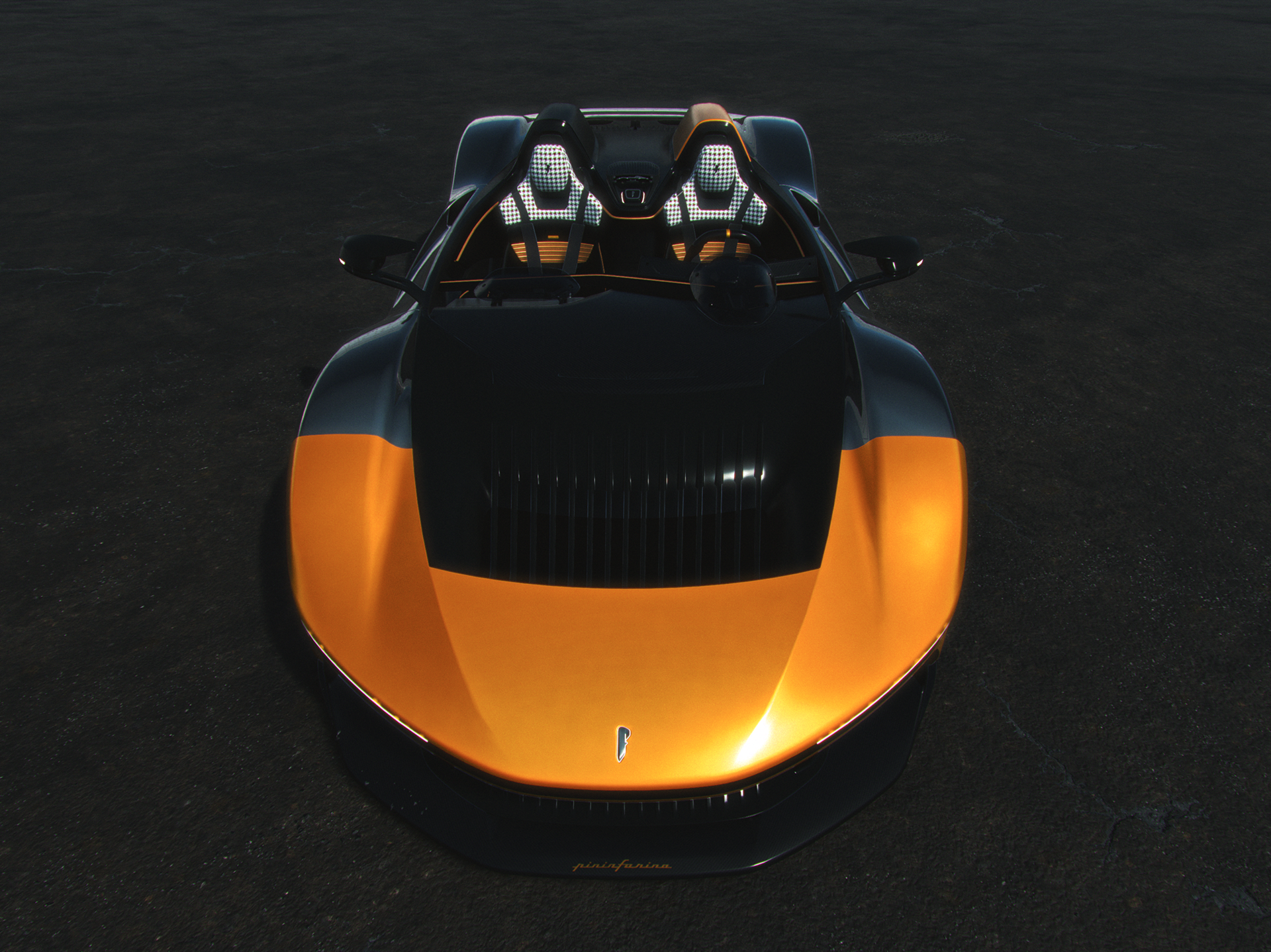
High-Angle Front Three-Quarter — Cockpit & Hood - An elevated composition revealing the open cockpit, patterned seats, roll-hoop accent, metallic paint response, and high-gloss intake surfaces.
Photoshop Post-Processing
Still renders were processed in Adobe Photoshop using Camera Raw as part of the finishing stage. Initial adjustments focused on exposure, contrast, highlights, shadows, texture, clarity, and sharpening to control the photographic response of the render. Multiple masks were then used to separate major image regions. The vehicle was isolated for additional sharpness and detail enhancement, while the sky received a separate treatment to introduce slightly greater vibrancy and atmospheric haze.
The road surface was also isolated so that asphalt detail and local contrast could be enhanced independently from the vehicle and background. This masking approach allowed the final image to be sharpened selectively rather than applying a uniform treatment across the entire frame.


High Aerial Top-Down — Track Wall Composition - A high-angle aerial view using the banked retaining wall as a compositional axis while revealing the vehicle footprint and asymmetric colour treatment. / Full Driver-Side Elevation - A clean side profile focused on the speedster silhouette, long wheelbase, side intake geometry, and relationship between vehicle and concrete banking. / Front Three-Quarter — Track Wall Angle - A dynamic front three-quarter view concentrating on the yellow nose, thin front light strip, front arches, and louvered bonnet structure under direct sunlight. / Direct Front Top-Down Close-Up - A tight overhead detail of the nose, splitter, bonnet louvers, and Pininfarina badging, using the paint transition to emphasise the curvature of the front section.
Analogue Image Finishing
After the technical adjustments, additional camera-style artefacts and optical treatments were introduced to reduce the overly clean appearance of the real-time render. These effects were used selectively to simulate characteristics normally associated with photographic acquisition and lens behaviour. The objective was not to intentionally degrade the render, but to remove some of the visual cues that can cause a CG image to feel overly perfect, particularly in areas of uniform colour, smooth highlights, and digitally clean edges.
Top-Down Planar View — Nose to Tail - A direct overhead composition exposing the complete top deck, dual-tone paint division, open cockpit, and louvered front structure.
DaVinci Resolve Workflow
The animated EXR sequences were brought into DaVinci Resolve for the corresponding video finishing process. The workflow followed the same broad structure used for the still images: primary exposure and contrast adjustment, selective masking, local enhancement, and final image finishing. The vehicle, sky, and track were treated as separate image regions wherever additional control was required. This allowed the car's material definition to be sharpened without excessively increasing detail in the background or introducing unwanted noise into the sky. Additional Resolve processing and finishing effects were then used to introduce a more analogue cinematic response.
Outdoor Cinematic Realism
The main visual challenge of the project was making the CG vehicle and environment respond convincingly to the same outdoor lighting system. Unlike a studio scene, the image was required to contain a large amount of visual information: sky, mountains, track surface, concrete barrier, sunlight, reflections, vehicle paint, cockpit materials, and environmental detail. The solution was to maintain a consistent hierarchy in which the sunlight established the primary direction, the environment provided secondary reflections and colour influence, and post-production refined the resulting image rather than replacing the lighting logic. This kept the B95 integrated into the environment instead of appearing as an isolated model placed over a background.
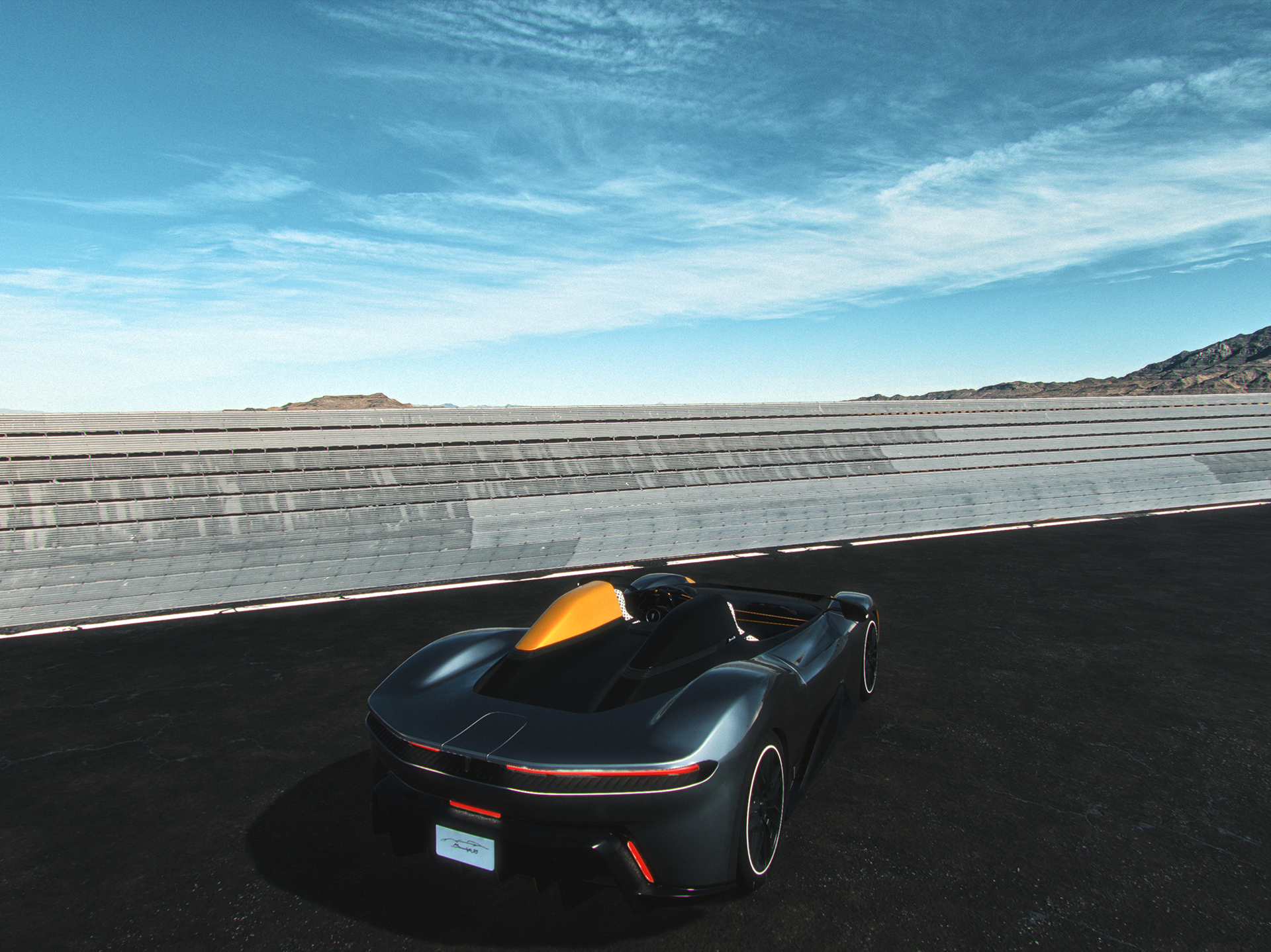


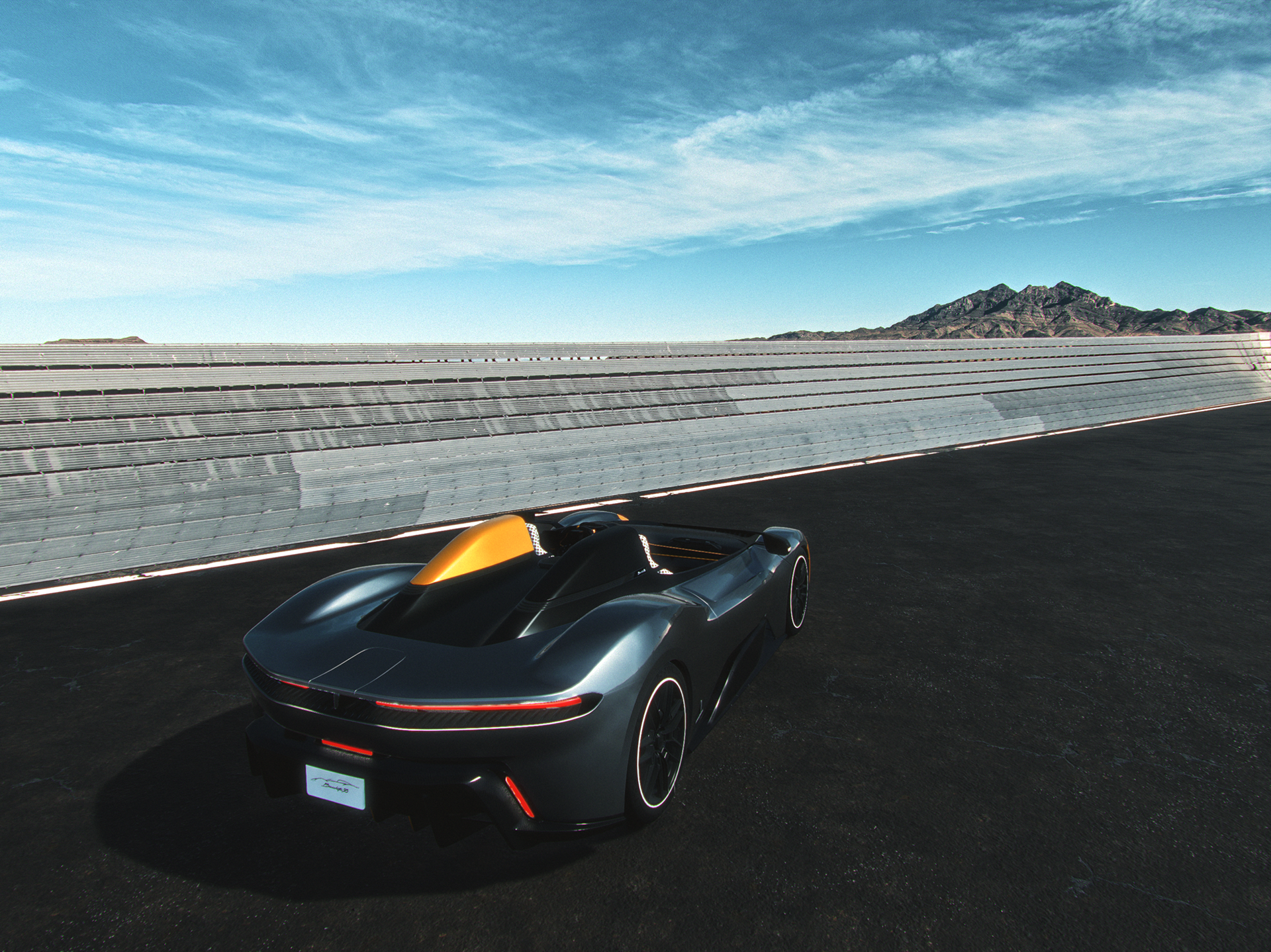
Rear Three-Quarter Low Angle — Wide Track View - A ground-level perspective designed to emphasise the rear track width, diffuser geometry, and sculpted rear bodywork under hard directional sunlight. / Rear High Three-Quarter — Dynamic Track Framing - An elevated rear composition revealing the open cockpit, twin-buttress structure, and continuous shoulder line while integrating the vehicle with the banked concrete barrier. / Tight Rear Three-Quarter — Diffuser & Rear Deck - A compressed rear crop concentrating on the rear fascia, carbon aero elements, exhaust outlets, and light blade, with strong daylight producing controlled metallic highlights. / Distant Rear Three-Quarter — Environmental View - A wide environmental composition placing the B95 within the track landscape and mountain horizon, using scale and negative space to emphasise its low-slung profile.
What This Project Demonstrated
The B95 project expanded my Unreal Engine workflow from controlled studio illumination into environmentally driven outdoor cinematography. The key technical learning came from understanding how strong daylight exposes material weaknesses, how custom automotive paint responds across changing surface orientations, and how a procedural landscape shader can prevent repetition across a large visible track surface. The project also demonstrated the importance of working around real production constraints. The CGI Backgrounds environment limited camera movement and usable perspective, but rather than treating that as a blocker, the camera and composition were developed inside the asset's practical coverage range. The final workflow combined custom vehicle materials, procedural landscape texturing, decals, environmental modification, constrained camera design, 16-bit EXR rendering, selective image masking, Camera Raw processing, and DaVinci Resolve finishing.
Outcome
The final B95 visualisation series was developed around the idea of making a relatively modest CG asset perform convincingly under demanding outdoor conditions. The project successfully combined automotive material development, procedural environment construction, outdoor lighting, constrained virtual cinematography, surface detailing, and post-production into a unified visualisation pipeline. More importantly, it established a stronger understanding of how realistic automotive CGI depends not only on the vehicle asset itself, but on the relationship between paint response, environmental reflections, landscape detail, sunlight direction, camera placement, atmospheric scale, and final image treatment.
